MobileCrunch |  |

- HTC Vigor Packs Beats Audio, LTE, But No DROID Branding?
- Samsung Asks To Ban iPads, iPhones In The Netherlands
- “Another World” Finds New Life On iOS, Still Crazy Hard
- Samsung: Apple’s Been “Freeriding,” We’re Getting Aggressive
- Touch Panel Defects To Affect iPhone 5 Availability?
- StartApp’s New Monetization Platform For Android Bundles Search With Apps
| HTC Vigor Packs Beats Audio, LTE, But No DROID Branding? Posted: 23 Sep 2011 03:31 PM PDT  Here’s a noodle-scratcher to ponder over the weekend: the HTC Vigor was supposedly going to hit Verizon as the Droid Incredible HD, but files leaked from the forthcoming device hint that the phone may not carry the Droid distinction after all. Someone who was lucky enough to have a Vigor in their possession managed to rip the device’s boot sequence, wallpapers, and sound files, and shared their findings with AndroidPolice. When the Vigor is fired up, it runs through the HTC, Beats, and Verizon LTE logos in quick succession, but something is strangely absent. The animation lacks the traditional giant red eye that has graced all of Verizon’s Droid series phones. Considering that the eye has been a strong part of Verizon’s Droid branding efforts, it doesn’t make sense to ditch it so unceremoniously. On top of that, the phone’s notification sounds were also released, and to my dismay there was no “DRROOOOOOID” sound to be found. It’s possible that the eye is to be added to the boot sequence later, and the sounds weren’t properly dumped, but it looks at this stage that the Bionic will rule the Droid roost for the time being. Though the boot sequence manages to raise a question or two, the wallpapers that come with the phone manage to answer one. The wallpapers are all 1440×1280 in size, meaning that it’s quite possible the Vigor’s display will run at the reported 1280×720, making it one of the first 720p Android phones. Unless something gets changed between now and the phone’s release, these files cast quite a bit of doubt on last week’s leaked Verizon document. I’m still holding out hope that it’s real though, if only because I do so love the idea of an October launch.
|
| Samsung Asks To Ban iPads, iPhones In The Netherlands Posted: 23 Sep 2011 11:12 AM PDT  So remember that one time I said that Samsung was planning on stepping up its game against Apple? That was no joke. In the same court that granted an EU-wide injunction against three of its Galaxy smartphones, the Hague Court in the Netherlands, Samsung has asked that the iPhone and iPad get pulled from shelves. Rather than being based on design (like Apple’s GalTab injunction request), this complaint is based solely on 3G technology patents held by Samsung and is aimed specifically at the iPhone 3GS, iPhone 4, and both generations of the iPad. Within the request, as seen by Webwereld, Samsung claims that all four of those products infringe on four different Samsung patents. The preliminary injunction request asks that Apple be banned from trading, importing or selling these devices within the Netherlands. Past that, Samsung also wants all current iPhone and iPad models pulled from store shelves. The four patents in question are the same ones that Samsung has brought against Apple across much of the globe, including the U.S., France, Japan, the U.K. South Korea, and Germany. They are essentials patents, which means that they cover technology necessary to the industry as a whole. With essentials patents, the right holder must license the patents to third parties without discrimination — this is known as FRAND terms. Samsung has recently said that Apple was “freeriding” with regards to Samsung patents, and this may very well be the point at which Samsung cashes in. Obviously, a few bucks here and there from Apple would be nice, but what Samsung really needs is an injunction of some sort on any iProduct. As I mentioned in my earlier post, there’s very little chance of a settlement unless Samsung can prove to Apple that it won’t be knocked around. A ban on the iPhone or iPad would be ideal, whereas a licensing agreement is really just a continuation of this whole dramatic mess. Apple’s lawyers have set up a hearing in which both companies can discuss the FRAND licensing issues. This would allow for talk of an injunction to fall by the wayside, as Apple and Samsung would merely have to negotiate licensing fees. Of course if Apple refuses to take the licenses (which would be a shocking decision), then Samsung can move forward with its injunction request. Started by Steve Jobs, Steve Wozniak, and Ronald Wayne, Apple has expanded from computers to consumer electronics over the last 30 years, officially changing their name from Apple Computer, Inc. to Apple, Inc. in January 2007. Among the key offerings from Apple’s product line are: Pro line laptops (MacBook Pro) and desktops (Mac Pro), consumer line laptops (MacBook) and desktops (iMac), servers (Xserve), Apple TV, the Mac OS X and Mac OS X Server operating systems, the iPod (offered with... Samsung is one of the largest super-multinational companies in the world. It’s possibly best known for it’s subsidiary, Samsung Electronics, the largest electronics company in the world.
|
| “Another World” Finds New Life On iOS, Still Crazy Hard Posted: 23 Sep 2011 09:35 AM PDT  When it was released in 1991 on the Amiga, Another World was one of those games that drew you into its world from the very first second, and kept you at rapt attention even after you died countless times. The game has spent nearly two decades meandering from computer to console and vice versa, but Eric Chahi’s creation has just made the leap onto iOS just in time for its 20th anniversary. Another World is a platformer that follows a red-headed, Ferrari-driving physicist whose latest experiment launches him into an alien world. Better known as the less auspicious “Out Of This World” here in the States, the new app from DotEmu and BulkyPix plays things very close to the original. The pixelated retro look of the main character and the alien world in which he finds himself have been replaced with crisper visuals, but (thankfully) the game retains its quiet, alien charm. Purists will be glad to know, though, that the game’s original look is a quick two-finger swipe away. In order to attain the fluid motion that made Another World such an eye-opener, creator Chahi rotoscoped video of himself bounding over and picking up objects. In light of today’s hyper-realistic games, Chahi’s efforts may look quaint, but it’s sure to fill old-school gamers with a bit of nostalgia. No flash has been added to appeal to new audiences, and the unwavering difficulty remains the same — it’s a essentially a straight port of a classic, for better or worse. The biggest stumbling block that Another World has to contend with is the device that it’s now going to be played on. It was never an especially easy game, even when you had a trusty keyboard to work with, but playing it with a touchscreen adds another level of challenge to a game that doesn’t need it. Example: the beginning of the game requires you to run and bound over a few poisonous slugs, and then run in the opposite direction from a larger alien beastie. I played it for a bit and the game was as difficult as ever but the up and down swipes to swim, jump, and interact with objects were a bit easier on the iPad than I expected but still not quite there. Maybe my reflexes have dulled since last I played, but it took me several tries to guide the our protagonist through those first minutes of the game. The touch controls start to make more sense after a while, but (and this is critical) I never really like I had full control over my character. It’s a shame, really. Another World is one of those games that nerds (like myself) have put on a pedestal over the years, but the controls really mar what is otherwise a fond trip down memory lane. For those willing to deal with iffy controls to relive the good ol’ days, Another World costs $4.99 and is available in the App Store now.
|
| Samsung: Apple’s Been “Freeriding,” We’re Getting Aggressive Posted: 23 Sep 2011 07:37 AM PDT  If you were to take a good hard look at the Apple-Samsung trail of destruction (otherwise known as their world-wide patent war), you’d likely come to the conclusion that Apple is ahead by a few key points. Apple has taken down the Galaxy Tab 10.1 in Germany, won an EU-wide (sort of) injunction on three Galaxy smartphones (though Samsung’s found a way to keep selling them), and kept the GalTab from being sold in Australia as well. Samsung has yet to get any iProduct removed from store shelves. Obviously, this is an ongoing war and anything could happen, but as it rests now Apple has the advantage. With any win, however contained, the psychological affects of that win carry over into other court systems and countries. So Apple’s win is more than just a win in Europe, and a semi-win in Australia — it’s a sign to all the other courts that Apple may just have a point to their argument. To Samsung, this effect is lethal. With that said, Samsung’s head of global marketing for mobile communications Lee Younghee has said that Samsung plans to take a much more aggressive stance with regard to Apple, reports the AP. After hearing this, Samsung’s somewhat tentative attitude throughout these proceedings makes much more sense. It’s well known that Samsung and Apple share a fruitful business relationship, with Samsung being a component supplier for Apple and Apple, in turn, being one of Samsung’s biggest customers. Apple hasn’t done much to protect this relationship over the course of the battle, asserting rights in any country it can and alleging infringement at every turn. Of course, Samsung has filed plenty of its own lawsuits and appeals, but in almost every case it’s had the appearance of a retaliatory move, rather than a switch over to the offensive. In this way, Samsung has played the game slow and steady, refraining from crossing any line until the company is prepared to never return. But that’s over. Early on in the battle, Samsung almost seemed flattered by the lawsuits. Chairman of Samsung Electronics Lee Kun-hee said that “when a nail sticks out, people try to pound it down. [Such incidents] are like a rite of passage that the company has to go through in order to continue its growth.” That was back in April, when this whole mess began. Now, things are quite different. Apple is very clearly going for the jugular, while Samsung has merely been defending itself. A strong defense (with regards to the suits Samsung initiated), but a defense nonetheless. According to Lee Younghee, “We’ll be pursuing our rights for this in a more aggressive way from now on.” She also added that Apple has been “freeriding” on Samsung’s wireless communication technology patents. That aligns rather nicely with comments made by an unnamed Samsung executive to the Korea Times, promising to come after the iPhone 5 in Korea as soon as its debuted. That exec mentioned that the only way to avoid such litigation would be if Apple removed “mobile telecommunications functions” from the iPhone. The way I see it, Samsung is trying to turn the tables on Apple. After playing the victim role (to an extent), Samsung will likely begin dropping bombs, hoping to secure a solid win. If that happens, Apple’s advantage dies and the possibility of a settlement becomes much more attractive to Apple the aggressor. With the way the game’s been played thus far, a settlement is actually a big win for Samsung. It may preserve the business relationship it has with Apple, while proving to the world that Apple is indeed afraid of Samsung and its increasing growth. Samsung is one of the largest super-multinational companies in the world. It’s possibly best known for it’s subsidiary, Samsung Electronics, the largest electronics company in the world.
|
| Touch Panel Defects To Affect iPhone 5 Availability? Posted: 23 Sep 2011 07:10 AM PDT  While it’s near impossible to say what exactly Apple has in store for us come October, a new report from DigiTimes reveals that there may be fewer iPhone 5s to go around if it indeed makes its debut. Some of the iPhone 5 touch panels that manufacturer Wintek has assembled are turning out to be defective, and could potentially cause a supply shortage come launch day. The displays are plagued by what are called “delayed bubbles,” where small pockets of gas are trapped between the touch panel and the lamination layer. It’s apparently a tough defect to avoid during the production process, and it’s made even worse as it’s usually only spotted during assembly. DigiTimes reports that it’s a minor gaffe as far as fixes are concerned: the iPhone 5 uses the same manufacturing process as its predecessor, and sources say Wintek is expected to rectify things pretty quickly. The company, who is said to be producing about 20 to 25% of the iPhone 5′s touch panels, would likely agree with that sentiment. Though Wintek has kept quiet about how many of their panels have been affected, the official statement is that all orders will ship on schedule. Though Wintek accounts for a smaller fraction of the production workload (TPK Holding and Chimei Innolux are working on the remaining 75-80%), DigiTimes sources say Apple is hoping to ship nearly 26 million iPhone 5s in Q4. In order to hit those numbers, Apple is going to need all their hardware partners on deck, and Wintek needs to brush themselves off and get back to work.
|
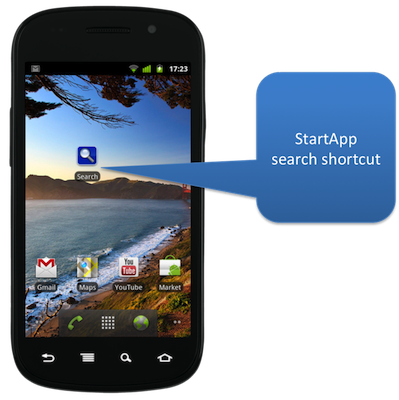
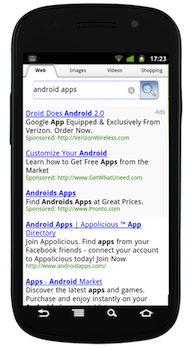
| StartApp’s New Monetization Platform For Android Bundles Search With Apps Posted: 23 Sep 2011 07:01 AM PDT  StartApp is a new monetization and distribution platform for Android applications designed to address the challenges the platform has created in terms of revenue generation for developers. Using the new StartApp SDK (software development kit), developers can receive $10 – $50 per 1,000 downloads, the company claims. This is higher than the $4 average per 1,000 downloads developers see elsewhere, StartApp says. Sounds great, right? What’s the catch? When Android users download StartApp-monetized applications to their phone, a new search icon and bookmark link appear on the device automatically. That’s right – bundled software! It’s not all that different from the ad-ware supported desktop applications of years past. Whenever a user searches the Web via StartApp’s portal, StartApp generates revenue which can then be shared with the developer. Developers have two options for payments: either up-front pay-per-downloads or ongoing revenue sharing from the new search option. The up-front model provides $50 per 1,000 downloads in the U.S. and $10 per 1,000 international downloads. To be clear, StartApp requires that developers explain to users that the new search option is a part of the download, that it doesn’t replace any default options they have and if users don’t want to use it, the icon can simply be deleted from their homescreen. Prior to the company’s official launch (planned for Tuesday), StartApp has been integrated into 50 apps and has seen nearly 1 million downloads. Given developers failure to effectively monetize applications on Android, it’s not surprising that new revenue models are being created. For example, earlier this month, third-party mobile application store GetJar introduced a premium catalog of free Android apps, sponsored by featured search listings on the GetJar site. The difference between the GetJar model and StartApp, however, is not just in how they leverage search as a monetization mechanism, but in their willingness to aggravate the end user. In GetJar’s case, there’s barely a problem – some app listings in search results are marked “featured.” In StartApp’s case, though, users have to perform cleanup on their devices to remove the extra icon and bookmark. Unfortunately, many users will not be savvy enough to do so. And the innocuous “search” icon will be tapped again and again. This may be an effective revenue model as StartApp claims, but at what cost to the overall Android ecosystem? That’s a question developers, especially Android-only developers, should carefully consider.
|
| You are subscribed to email updates from TechCrunch » Mobile To stop receiving these emails, you may unsubscribe now. | Email delivery powered by Google |
| Google Inc., 20 West Kinzie, Chicago IL USA 60610 | |